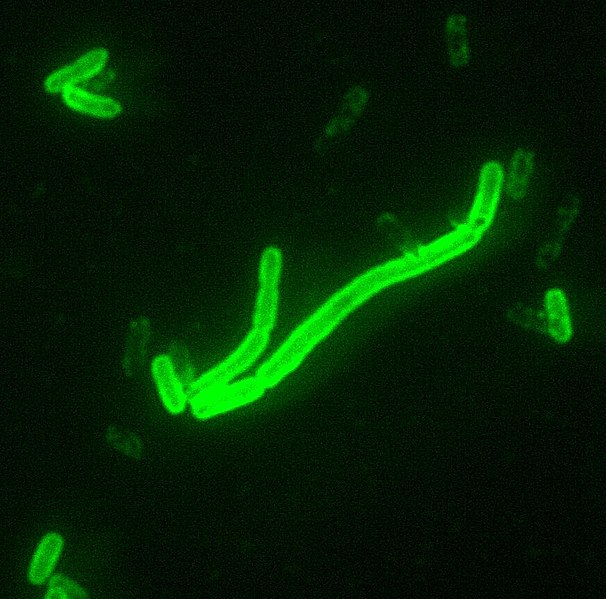
In a recent article a group of German and Canadian researchers presented the genome of Yersinia pestis as it has been extracted from burials of the London East Smithfield burial ground dated to 1348/49 (Bos et al. 2011). This site has been excavated by the Museum of London after it has been localised in 1986 (Grainger et al. 2008).
The article aims at the reconstruction of the ancient genome of Yersinia pestis, as this promises implications for the understanding of infectious diseases, as "genomic data from ancient microbes may help to elucidate mechanisms of pathogen evolution and adaptation for emerging and re-emerging infections".
The authors conclude:
1.) "Genetic architecture and phylogenetic analysis indicate that the ancient organism is ancestral to most extant strains and sits very close to the ancestral node of all Y. pestis commonly associated with human infection. Temporal estimates suggest that the Black Death of 1347–1351 was the main historical event responsible for the introduction and widespread dissemination of the ancestor to all currently circulating Y. pestis strains pathogenic to humans." The classic Black Death was quite different from previous epidemics. The authors refer to the Justinian plague "popularly assumed to have resulted from the same pathogen: our temporal estimates imply that the pandemic was either caused by a Y. pestis variant that is distinct from all currently circulating strains commonly associated with human infections, or it was another disease altogether."
2.) "Comparisons against modern genomes reveal no unique derived positions in the medieval organism, indicating that the perceived increased virulence of the disease during the Black Death may not have been due to bacterial phenotype. These findings support the notion that factors other than microbial genetics, such as environment, vector dynamics and host susceptibility, should be at the forefront of epidemiological discussions regarding emerging Y. pestis infections."